Visual Empathy – Reflections on Capturing Poverty Through a Stigma-Free Lens

Introduction
In this article, we share the process of how photography and imagery can be developed through an “anti-stigma” lens. We also outline how we went about working in coalition between the Stigma Power and Poverty Design team, JRF teams and alongside photographer Sukhy Hullait, and how we built in learning as a key objective and output of this project.
At the Joseph Rowntree Foundation (JRF) imagery plays an important role throughout our work. It needs to be reflective of the breadth of JRF’s strategy and mission to speed up the transition to a future free from poverty, whilst conveying the sense of hope and dignity that underpins these aims - and crucially needs to be reflective of how people see themselves and their communities.
JRF's old website was becoming increasingly reliant on the use of carefully selected stock imagery to represent our topics and different themes of work, however, we grew increasingly aware that these images were not always representative of how people with lived experience of poverty see themselves or their communities. We, therefore, developed a brief to create a set of representative images to coincide with the launch of the new JRF website (which launched in December 2023). We set out to learn more about representation, develop guiding principles and use these to capture the reality of poverty facing people and communities affected by the injustice of poverty in the UK today, and use the JRF website and the new topic pages as a vehicle to showcase this work.

How the coalition began
Whilst the work on JRF’s brand refresh and new website development was in the early stages of kicking off in 2023, separately JRF recruited and brought together a design team made up of people from a range of backgrounds, identities and disciplines to explore stigma and poverty and prioritise areas of investment for a JRF programme of work to address it. The group is as diverse in lived and learned experience, as it is in perspectives and expertise, all of which fed into the intersectional analysis that the group collaboratively undertook, ultimately enabling its members to creatively, collectively examine the relationship between stigma and poverty and formulate ways to address it.
Almost a year on, when the stigma team’s ideas had started to take shape, and notions of a “stigma-free future” were becoming more solidified, the group were invited to put these ideas into practice – by working in coalition^1 with JRF on the representative image brief for the new website.
From the outset, we wanted to approach this as one team of collaborators, so the first step we took was to discuss everyone's motivations to be involved, how we wanted to work together (including being clear on where power sharing on decision-making would take place) and how we wanted to form a structured project plan which would allow for input and engagement from everyone involved.
Motivations for taking part:
(Nkechi/ Stigma Design Team perspective)
For several reasons, this work piqued my interest - I volunteered myself under the guise of my existing interest and prior dabbles in photography, but I also knew deep down that despite my excitement and enjoyment of the exploration phases of the stigma project - at times this anti-stigma world felt intangible and elusive. In a way, using photography to visualise and illuminate our concepts, ideas, and hopes would enable me to prove to myself, and by extension, a broader audience, that aspirations of a society free from stigma could be practicable and our principles applicable - and this project was key to demonstrating that.
(Ryan/ JRF perspective)
Collaboratively working on this project with the Stigma Design Team and other partners made sense for several reasons. Fundamentally at the heart of the brief was to create a set of representative images that portrayed people and communities living in poverty across the UK in a more hopeful and positive way. Being able to collaborate on this project and bring in such a diversity of experience and perspectives made absolute sense, not only to ensure we delivered on this key objective but also to ensure that we integrated the process and decision-making throughout the project to ensure the process was ethical and prioritising the people and communities who were ultimately to be featured in the final images.
Working in coalition
With a four-month timeline to complete the project, we kicked things off by first agreeing on shared ways of working and how with multiple stakeholders involved we would develop a coalitional approach where everyone could feed in and have an equal say, we wanted an open approach built on trust and honesty. We acknowledged from the outset that it was really important to bring a learning lens to this work throughout (we knew we didn’t have all the answers so it was really important to be creative, flexible and open to ideas and thinking). We also acknowledged that time wasn’t on our side therefore we were not going for absolute perfection but willing to learn along the way. Having these jointly formed agreed ways of working in place at the start meant that we could keep referring to these throughout the project.
Developing the brief
Next, we looked to develop the brief further, looking in more depth at the challenge we were looking to address through group research and discovery. Whilst the design team had touched on the role of the media in upholding and shaping stigma, previously, this was often part of examples that fed into broader strands of its work. To strengthen the ideas that would underpin this project, we individually selected examples of stigma in the media, shared them with the group, and took turns facilitating debate on what was problematic and stigmatising about the images, as well as identifying images that challenged and dispelled stigma - and why we thought they did this. We used the images to facilitate and guide preliminary discussion on what we sought to challenge with the work that we were undertaking, and what we hoped to achieve, this formed the basis of what would be turned into a creative brief and set of ethical visual principles which would guide our decisions throughout the process.
After this and keeping our learning objective core to our approach, we then undertook learning on ethical storytelling, looking at ethical considerations throughout the image-making process and how imagery can be a powerful tool for challenging stereotypes and commonly held beliefs. An ethical storytelling and participatory specialist - Kate Watson - guided us to explore this topic looking at all stages of the image production process from pre-production (planning), production (making the images) through to post-production (selecting and editing the images). We looked at how important it is to consider creative ways to develop imagery that doesn’t always feature recognisable people, the importance of captioning images and being clear on the context where an image will be used. We also looked at when imagery does feature recognisable people, and the importance of protecting those people by having a proper informed consent process in place that signifies that consent has been given freely and all stakeholders involved can clearly understand the implications. This workshop provided additional tools to develop our processes and ethical visual principles further. We immediately made changes to our internal processes following this work including developing a clearly structured informed consent process, but we are very aware that this needs to be under continuous review to ensure that the wellbeing and safety of those that take part take priority over the need for an image or story.

Alongside the workshops and preliminary findings from our research, our ethical visual principles sought to embody the values core to JRF, and the emerging work of the stigma design team. After several collaborative sessions, we landed on the following list of guiding principles:
Power sharing and collaboration
Listening and non-imposing
Evoking strength, resilience, and empowerment
Images that are warm, hopeful, natural, and real
Subjects on the same level - both literally and figuratively - we never wanted them framed as being looked down on
Informed - by lived experience and the perspectives of those in them
These principles serve as a guide throughout the project including guiding our approach to shortlisting and selecting the photographers we would partner with. During our research, we came across numerous photographers that were great candidates who embodied these principles in their work. Their portfolios stretched across several areas of focus, and did not just focus on depicting poverty and hardship, rather had a consistent thread of producing reflective imagery of communities and people across the UK.
These ethical principles were also used to provoke debate and challenge each other to look beyond the visual elements of a photographer’s work alone – prospective photographers were asked to share their motivation for responding to the brief, their interpretations of our guiding principles, and how they would apply them.
After a shortlisting process underpinned by these principles, we were delighted to partner with Sukhy Hullait, who shared a passion, understanding, and appreciation of what we sought to do.
The Photographer's Role
As well as appreciating the crucial role of the photographer – we recognised and valued the unique perspective and approach they would bring to this work. To balance their perspective and our principles was a careful process and so we got to know, Sukhy, to understand his motivations and found that he surpassed our expectations in embodying our principles of respect, dignity, and empowerment. He framed the individuals in the photographs in a way that went beyond simply capturing an image, his ethos is to portray people positively and authentically. Sukhy's extensive network of contacts and strong community roots were particularly important for this project and were often relied upon due to time constraints. Another aspect we were particularly drawn to was that Sukhy works in film photography. Film photos have a warmer, gentler feel than the more clinical digital alternatives which we felt was important for this project.
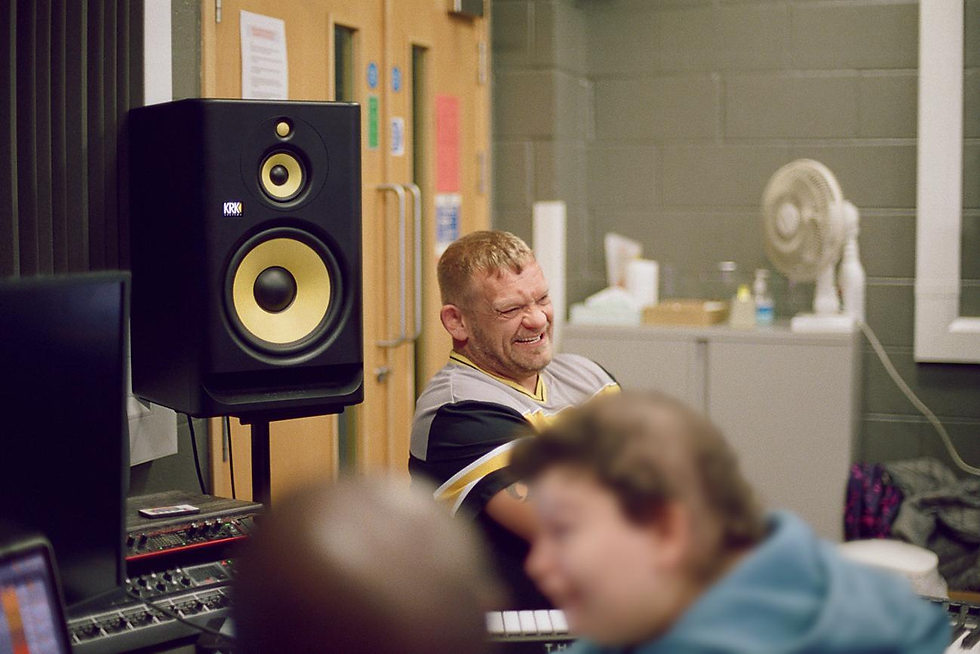
Arguably, photography inherently objectifies its subjects to some extent, but Sukhy transcended this limitation. He captured more than moments – encapsulating the joy and relief of a proud, hard-working chef taking a break behind a restaurant and the strength and pride of communities uniting to garden or cook. These aspects were crucial because they offered a balanced portrayal of people often stigmatised, challenging the common tropes that reduce the experiences of these individuals to one-dimensional portrayals devoid of joy, connection, and determination. We understood that visualising a stigma-free future didn't mean avoiding the reality of the hardship that accompanies experiencing poverty. Rather, we aimed to ensure the individuals we captured felt empowered to "make the photo," as Sukhy put it, and to shape how they were being represented alongside us. The term "a picture paints a thousand words” may be a cliché, but it was apt for this work. Stigma is shaped and reinforced by imagery and media just as much as it is by words.
Guided by the strong belief that topics captured by photography should be nuanced rather than regarded as neutral, we aimed to strike an authentic balance through the scenes and individuals captured in this project. As Maureen Cherongis states in her blog piece for Bond; “the use of a single static image to represent complex and dynamic situations can indeed lead to misunderstandings and misrepresentations. Photos do not reflect the fluidity of a situation; they only represent a one-time scenario.” We aimed to prioritise capturing and representing this fluidity, reality, and lived experiences of those in poverty, without glossing over the inevitably negative aspects. Continuous co-production was crucial for this, and mitigating the flatness that can be perpetuated through imagery, allowing participants the freedom to highlight a negative aspect of their experience in the image if they chose to do so. Each image produced allowed participants to share what gave them strength, encouragement, and motivation, despite the circumstances - words not typically associated with those experiencing poverty or evoked by typical images or discussion of the topic.
Another way that we stayed true to our aim of continuously co-producing included capturing the feedback of image participants, post-shoot. Asking them to reaffirm their consent to be in the images and whether they liked how they were represented. Sukhy visited and handed everyone a printed copy of their image who had taken part in the project, including those who decided to opt out of sharing their image in the final commission.
Learning and continuous improvement
The role of the photographer in this project offered great inspiration and learning opportunities, but it also presented challenges due to the tight deadline. One crucial consideration was the extra time and care needed when working with a photographer who possesses empathy and a deep understanding of our work's themes. Despite our efforts, the fast-paced nature of the project didn't always allow enough time for research, recovery, rest, and self-care. For others considering a similar project, it's vital to mitigate the emotional toll and ensure adequate time for the photographer to do adequate reading, learning, studying locations, picture research, learning about the client and so on to yield better results having formed deeper connections.
Another crucial learning we took was the importance of developing a self-care plan with potential artists upfront (and not waiting for them to ask for this to be put in place) and discussing any specific requirements for support before a project begins. It’s important to consider if a project such as this puts the photographer in a difficult position and if so what level of support is being offered, particularly if the artists you choose to work with are less experienced. Regular check-ins with photographers periodically throughout the project regarding their well-being are also crucial. This is also even more important when crafting a new perspective and approach with limited reference points for best practices or concrete examples for inspiration.
Impact Quotes
To demonstrate the perceived impact of the images, we gathered quotes from participants who are in the images, staff from the JRF team, and design team members. Here are some of them:
‘It felt right! It felt like it meant it! It felt connected – not just a photo, it felt personal – not just a photo’. (Design Team perspective)
'Blew usual stereotypes about poverty (and its effects) out of the water – gardening, cooking – normalising people – doing the things every human does. Reinforced the idea that people living with poverty are interested in their environment (community garden photos) – it is an antidote to ‘othering’. (Design Team perspective)
More informed, deeper level of work makes this much more meaningful – it is much bigger than just a selection of photographs. The learning is bigger than the photos and the project itself. (Design Team perspective)
The reciprocal nature of the approach led to more creativity and ideas (JRF perspective).
We were able to give a clear and confident steer to Sukhy thanks to this way of working (JRF perspective)
‘We received copies of the photos from Sukhy and are really pleased with them. We're happy to participate further should an opportunity arise’ (Picture participant)
‘I love this image’ (Picture participant)
‘The photos are filled with more hope and positivity as a result of the process we' adopted’ (JRF perspective)
The principles and the diversity of the team ensured thoughtful decisions throughout and a confidence that what we were doing was right. No-one can say these photos are stigmatising and if they did we would have really strong case for how we made the decisions we did (JRF perspective)
Conclusion and Invitation
Reflecting on this project, we often think about our photographer, Sukhy, and how he described his work as “making a photo,” rather than “taking a picture.” This choice of words wasn't just incidental; it perfectly encapsulated the essence of our project, which was about making, not taking. We aimed to not take advantage of anyone, or take away their dignity, as stigmatising images can often do, but to collaborate with the people in the images, photographer Sukhy Hullait, the Stigma Free Futures design team, and JRF to make something meaningful and transformative. Our objective was to make a change in how individuals experiencing poverty are portrayed, whilst also ensuring that the image-making process was ethical and prioritising the communities and people affected by injustice of poverty across the UK above final outputs. We acknowledge that we didn’t get everything right in the project, but we have developed lots of learnings in a short space of time that has already been taken into future content commissions across JRF and will continue to do so.
There were times during the project when the task of dismantling stigma felt overwhelming. It often seemed like an insurmountable challenge in a world where systems that perpetuate inequality make poverty seem inevitable. We have grappled with the idea of a completely stigma-free world—could such a thing even exist? However, the images we produced during this project have provided a glimpse of what that world might look like. They are a snapshot of a possible future, a world where our hopes for a more equitable society are realised, and perceptions and understandings are transformed.
If our principles and processes resonate with you, or if you're interested in shifting conversations around stigma and inequality within your organisation, we invite you to get in touch. We're eager to share our learning and learn from you.
Notes
Coalitional ways of working must include people with current experiences of poverty, but in ways that move beyond tokenistic or extractive forms of ‘lived experience’ or ‘service user’ inclusion. Coalitional working disrupts the dichotomy of top-down vs bottom-up approaches by acknowledging that all forms of expertise are required to remedy poverty and poverty stigma. Coalitions function through listening relationships and hold spaces for members to lean into tensions and disputes.

Comments